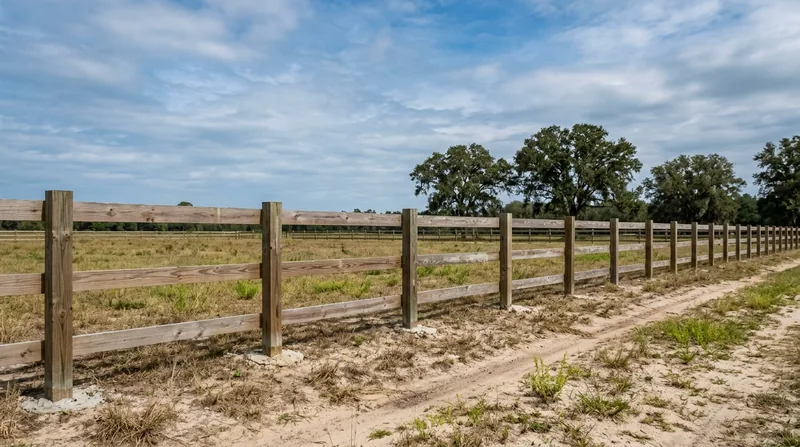




Farm fence installation in Jacksonville requires a practical understanding of sandy coastal-plain soil, salt air corrosion, and the wind loads that come with an open property. Whether you're fencing acreage in Clay County, Nassau County, or the rural edges of Duval, the posts have to sit deep and solid in ground that drains fast and holds a footing poorly. We've been installing and repairing farm and ranch fences since 2014, working with pressure-treated wood, no-climb horse fence, split rail, pipe, and wire fencing on the properties where Jacksonville families actually raise livestock and work the land. This guide covers what works on Jacksonville acreage, how we build it, what it costs, and how to hire the right crew for the job.
Why Farm and Ranch Fencing Matters on Jacksonville Acreage
Jacksonville's surrounding counties are horse country and cattle country. The soil is sand over clay, which means post holes need to go deeper and wider than they would in clay-heavy regions, and the concrete footing has to carry the load that dense earth would otherwise share. Salt air near the coast attacks galvanizing and fasteners, so material choice here is driven by durability as much as looks. A fence that holds on clay will fail on sand if you don't account for the difference in bearing capacity and drainage.
- Posts set in concrete at proper depth prevent frost heave and sand migration, even though Jacksonville never freezes.
- Pressure-treated pine and cedar rails resist the rot that sustained humidity brings to the ground line on acreage.
- No-climb horse fence and pipe fencing handle livestock pressure and wind load better than light residential wire.
- Split rail and ornamental pipe fencing define property lines and contain animals on large, open lots.
- Barbed wire and combination fencing systems protect pasture boundaries and working areas.
Each of these approaches solves a specific problem on Jacksonville and Clay County properties.
Key info: Florida 811 utility locates are required by law before you dig any post holes. We handle the locate request and mark the fence line before breaking ground. This protects buried power, water, gas, and communications lines on your property and your neighbors' property.
For permit and setback requirements, check with your county building department or city code office. Rules vary across Greater Jacksonville, and deed restrictions or HOA rules may also apply to height, material, and color on master-planned properties. We work from your existing survey and install on the line you identify.
For more on fence repair and post replacement on existing acreage fences, see our fence post repair and replacement service.
How We Install Farm and Ranch Fencing in Jacksonville: Step by Step
Installing a durable farm fence on Jacksonville acreage starts with understanding the ground and the job. We mark the fence line using your survey, call for utility locates, dig post holes to the correct depth and diameter for sand soil, set posts in concrete, and then build the fence structure on top. The method changes based on whether you're building wood, wire, or pipe fencing, but the foundation is always the same: solid posts in deep holes.
- We locate your property line using your existing survey and mark the fence alignment before any digging.
- Florida 811 utility locates are requested and marked to protect buried lines on your property and neighbors' land.
- Post holes are dug to 30 to 36 inches deep in Jacksonville sand, with diameter matching post size and load requirement.
- Posts are set in concrete, not tamped, so they stay solid as sand settles and drains around the footing.
- Rails, stringers, or wire are attached at proper spacing to handle livestock pressure and wind load.
- Racked or stepped installation is used on uneven ground to keep the fence line level and the structure tight.
The entire process, from survey to finished fence, takes 3 to 5 business days for a typical half-mile run on acreage, depending on ground conditions and material choice.
Example: A property owner in Orange Park with a 10-acre pasture needed a no-climb horse fence to contain two horses and separate a working area from the road. We set posts every 6 feet, used pressure-treated 4x4 posts in concrete, and installed 4-inch no-climb mesh with treated rails. The job took 4 days and held up through two seasons of wind and humidity without sagging or rust.
For details on fence replacement and removal if you're tearing out old fencing first, see that service page.
Farm and Ranch Fencing Methods and Materials
| Fencing Type | Description | Best for Jacksonville Acreage |
|---|---|---|
| No-Climb Horse Fence | Pressure-treated wood frame with welded 4-inch mesh, prevents hooves from catching and climbing. | Horse pastures, working areas, properties with young animals or nervous stock. |
| Split Rail Fence | Classic 2x6 or 2x8 rails mortised into 4x4 posts, rustic appearance, moderate livestock containment. | Property definition, aesthetic boundaries, light grazing, rural residential estates. |
| Pipe and Cable Fencing | 2-inch steel pipe posts with 1/2-inch cable or smaller pipe horizontals, high tensile strength, minimal visual obstruction. | Large pastures, high-wind areas, cattle containment, durable perimeter fencing. |
| Wire and Barbed Wire Fencing | Galvanized or high-tensile wire on treated wood posts with tension bands and stretcher bars, traditional containment. | Pasture boundaries, working livestock areas, cost-effective acreage fencing, combination systems. |
| Ornamental Pipe and Metal Gates | Powder-coated steel or aluminum with self-closing hardware, cantilever or V-track design, durable entry points. | Driveway gates, pasture entrances, working areas, properties with multiple paddocks. |
Each method accounts for Jacksonville's sandy soil, salt air, wind, and the specific needs of livestock or land management. Pressure-treated wood handles moisture and rot risk at the ground line. Galvanized and powder-coated metals resist corrosion in the coastal environment. Post spacing, footing depth, and rail size are sized to the load and the ground conditions on your acreage.
Farm and Ranch Fencing Cost in Jacksonville: What to Expect
Farm and ranch fencing in Jacksonville starts at $14 per linear foot for basic wire or split rail on properly prepared posts, and ranges up to $35 to $50 per linear foot for no-climb horse fence with treated wood and welded mesh. A half-mile of fence (2,640 linear feet) on acreage can run from $37,000 for wire fencing to $90,000 for premium no-climb construction, depending on terrain, post spacing, and material grade.
The main factors that move the cost up or down are post depth and concrete volume (sand soil requires deeper holes and more concrete per post), material grade (pressure-treated pine versus cedar, galvanized versus powder-coated steel), mesh or wire gauge and opening size, and site access (rough terrain, dense vegetation, or distance from the road adds labor). A property with good access, level ground, and simple wire fencing will come in at the lower end. A pasture with sandy hollows, rocky patches, and a request for no-climb mesh with treated rails will run higher.
We recommend getting 2 to 3 estimates from crews who understand Jacksonville soil and coastal conditions. Ask each contractor how they handle post depth on sand, what warranty they offer on concrete-set posts, and whether they handle the 811 utility locate as part of the job. See our full pricing overview for more detail on material costs and labor rates.
For an accurate quote on your acreage, call us at (904) 643-6174 or use our contact page to request a free, no-obligation estimate. We'll visit your property, walk the fence line, and give you a firm price based on what we actually find on the ground.
Farm and Ranch Fencing Near Me: What Jacksonville Acreage Owners Should Know Before Hiring
Hiring the right fence contractor for acreage work means finding someone who understands Jacksonville's soil, knows how to set posts so they stay solid as sand drains and settles, and can advise you on material choice for salt air and wind. Don't choose based on price alone. A fence installed on shallow posts or with inadequate concrete will fail in 3 to 5 years. A fence installed properly will hold for 15 to 20 years, depending on material and maintenance.
Ask any contractor you interview how many years they've been doing farm and ranch fencing, whether they handle the 811 utility locate themselves, and what they charge if you need to replace a rotted post later. Check whether they carry full insurance and whether they understand local permit requirements in your county. If your property is in an HOA or master-planned community, confirm that the contractor can work within deed restrictions on height, material, or color. Get references from acreage properties, not just residential subdivisions, because the soil and wind conditions are completely different.
We've been installing and repairing farm fences in the Jacksonville area since 2014, and we're an AFA Member Installer (American Fence Association). We handle the 811 utility locate, set posts at the depth sand requires, and stand behind our work. For a free estimate on farm or ranch fencing near you, contact us today or call (904) 643-6174.
Farm & Ranch Fencing in Jacksonville: Pricing Guide
| Service | Price | Details |
|---|---|---|
| Wire and Barbed Wire Fencing | Starting at $14/ft | Galvanized wire on treated posts with tension bands and stretcher bars, includes concrete footing and basic post spacing |
| Split Rail Fence | Starting at $18/ft | Pressure-treated 2x6 or 2x8 rails mortised into 4x4 posts, concrete set, includes material and labor for rustic appearance |
| No-Climb Horse Fence | Starting at $28/ft | Treated wood frame with 4-inch welded mesh, concrete-set posts every 6 feet, includes all rails and hardware for livestock containment |
| Pipe and Cable Fencing | Starting at $32/ft | 2-inch steel pipe posts with 1/2-inch cable or pipe horizontals, powder-coated finish, concrete footing, high-wind and pasture-rated |
| Complex acreage or specialty gates | On estimate | Terrain, access, mixed materials, or cantilever gate installation require site visit to price accurately |
| Estimate and travel | Free | No obligation, response within 24 hours at (904) 643-6174, includes Jacksonville and surrounding counties |
Indicative pricing, the exact cost depends on square footage, finish, and site access. Free personalized estimate within 24h at (904) 643-6174.


